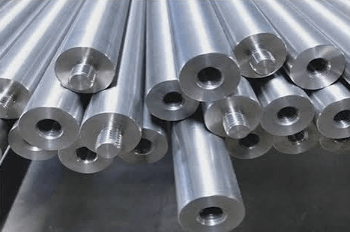
Industrial manufacturers continually look for materials that combine mechanical strength, manageable weight, and resistance to environmental damage. These requirements are particularly important in precision components, rotating assemblies, specialized machinery, and equipment operating under demanding conditions. Titanium alloys offer a useful combination of properties, making them a practical option when conventional metals do not fully meet a component’s design requirements.
Grade 5 titanium, also known as Ti-6Al-4V, is one of the most widely recognized titanium alloys. It is used in various engineered applications where its strength-to-weight characteristics are beneficial. Supplied in rod form, the alloy can serve as starting stock for machined parts, shafts, pins, fasteners, and other components, subject to the dimensions, material condition, and requirements of the intended application.
Understanding Grade 5 Titanium Rod
Grade 5 titanium is an alloy containing titanium, aluminium, and vanadium. Its properties differ from those of commercially pure titanium, and its suitability depends on the material specification, processing history, heat treatment, and final component design.
Rod stock is particularly useful when a manufacturer needs solid material for machining or further processing. Round bars can be cut to length and turned, drilled, milled, or otherwise machined into components. The required diameter, straightness, surface condition, and material condition depend on the production process.
Strength and weight considerations
Titanium alloys are valued for their relatively low density compared with many conventional structural metals, combined with useful strength. This can make them attractive for components where reducing mass is important without sacrificing required mechanical performance.
However, strength-to-weight ratio is only one part of material selection. Engineers must also consider stiffness, fatigue, wear, corrosion, manufacturing cost, availability, and the loads expected throughout the component’s service life.
For example, a component subject to repeated bending may need fatigue analysis, while a part exposed to sliding contact may require particular attention to surface treatment and wear behavior. Material selection should follow the component’s functional requirements rather than a general assumption that a stronger alloy is always the best choice.
Selecting the Appropriate Rod Specification
The dimensions and material condition of a titanium rod influence how easily it can be processed and whether the finished component meets its engineering tolerances. Buyers should define the required diameter, length, dimensional tolerance, straightness, surface condition, and applicable material standard before requesting quotations.
When reviewing titanium valleys Gr5 Titanium Rod confirm the precise alloy designation, available dimensions, mechanical-property requirements, product condition, and supporting material documentation. The manufacturer’s technical data should be used to verify compatibility with the intended application.
Material certification and traceability
A complete material specification helps avoid confusion between commercially pure titanium grades and titanium alloys. Similar-looking rods may have substantially different compositions and mechanical properties.
For quality-sensitive production, request the applicable material certificate and confirm that the delivered batch matches the purchase order. Records should identify the material grade, batch or heat number where applicable, dimensions, and inspection information required by the governing specification.
Traceability is especially important when multiple alloys are processed in the same workshop. Clear labels and separated storage areas reduce the risk of mixing materials and manufacturing components from the wrong stock.
Machining and Fabrication Considerations
Titanium alloys require appropriate machining practices. Tool selection, cutting speed, feed rate, workholding, and cooling strategy influence surface quality, dimensional accuracy, tool wear, and productivity.
Titanium’s material characteristics can cause machining challenges if the process is not designed appropriately. Heat may concentrate near the cutting edge, and tool-workpiece contact requires careful management. Manufacturers should follow qualified machining recommendations for the particular alloy and operation instead of applying settings developed for unrelated materials.
Controlling dimensional accuracy
A machined component may require tight tolerances for shaft fits, bearing seats, threads, or mating surfaces. These features should be planned at the drawing stage, along with inspection methods and acceptable surface finishes.
Workholding must prevent movement without distorting the component. Tool condition and machine stability should also be monitored, particularly during long production runs. Where a component has several critical dimensions, an inspection plan can help detect variation before a large batch is completed.
Surface condition and finishing
Surface finish affects more than appearance. Depending on the application, it may influence friction, wear, fatigue performance, corrosion behavior, and the quality of a mating interface.
Deburring and finishing should be performed using suitable procedures that do not introduce unacceptable surface damage. Where a component will undergo coating, joining, or additional treatment, the preparation process must be compatible with the subsequent operation.
See also: Crypto Technology and Market Innovation
Corrosion Resistance and Service Environment
Titanium forms a protective oxide layer that contributes to corrosion resistance in many environments. Nevertheless, performance depends on the chemical medium, concentration, temperature, flow conditions, and presence of other materials.
Engineers should confirm material compatibility before using a titanium rod in an aggressive chemical or high-temperature environment. The component’s mechanical loads and surface condition must be considered alongside corrosion behavior.
Contact with dissimilar metals can also require evaluation, particularly where moisture or an electrolyte is present. The suitability of a material combination depends on the design and environment rather than on the properties of the titanium alone.
Quality Control from Raw Stock to Finished Part
A reliable production process starts with receiving inspection and continues through machining and final verification. Incoming material should be checked against the purchase order, including dimensions, identification, surface condition, and documentation.
During production, manufacturers can monitor critical dimensions and surface characteristics at defined stages. This makes it easier to identify tool wear, setup errors, or unexpected material variation before components become nonconforming.
Finished parts should be inspected according to their drawings and applicable specifications. The necessary checks may include dimensional measurements, visual inspection, surface assessment, and additional testing where the application requires it.
If a component fails inspection, the cause should be investigated. Problems may result from incorrect stock, unsuitable machining parameters, workholding errors, tool wear, or inadequate process control. Correcting the underlying issue is more effective than repeatedly reworking defective parts.
FAQs
1. What is Grade 5 titanium rod used for?
It can serve as raw material for machined industrial and precision components where the alloy’s specified mechanical and environmental properties suit the design.
2. Is Grade 5 titanium rod suitable for every shaft or fastener?
No. Suitability depends on loads, dimensions, fatigue requirements, temperature, corrosion exposure, manufacturing method, and the applicable specification.
3. What should buyers verify before ordering titanium rod?
Confirm the alloy grade, diameter, length, tolerances, material condition, surface requirements, certification, batch traceability, and intended manufacturing process.
Conclusion
Grade 5 titanium rod offers manufacturers a versatile starting material for components that require a balance of strength and weight. Achieving dependable results requires a verified specification, suitable machining methods, careful dimensional control, and traceable material documentation. By evaluating the entire production and service process, engineers can make informed material choices and improve the consistency of finished components.

 By